Seedance 2.0 vs Seedance 2.5: Which AI Video Model to Use in 2026
Seedance 2.0 vs Seedance 2.5: what the upgrade changed, what it costs, and which model to use for short-form, client work, or people-focused video in 2026.
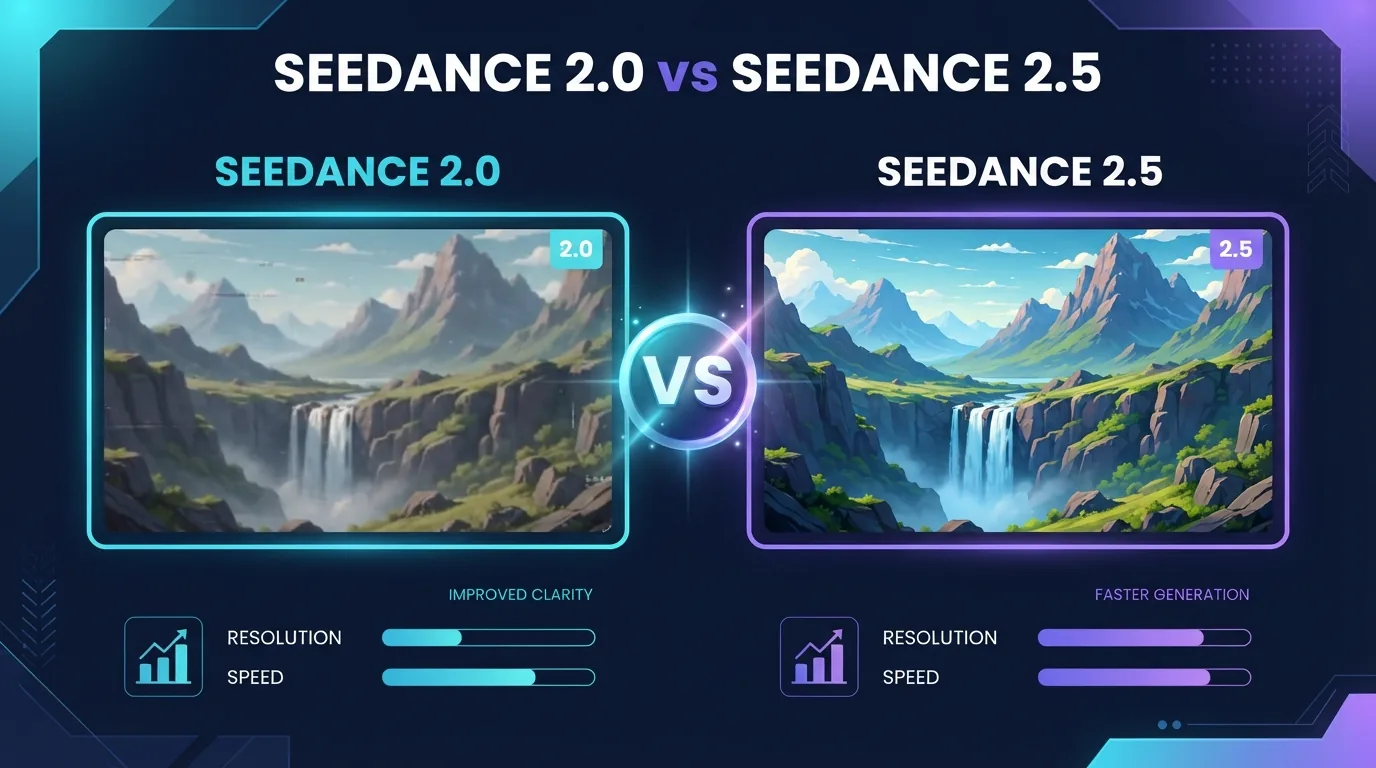
Seedance 2.0 vs Seedance 2.5: Which AI Video Model to Use in 2026
You paste the same prompt into two Seedance models and wait. One finishes in three minutes, the other in five. On your phone, both clips look fine. Then you open them on a 27-inch monitor and scrub frame by frame—and the differences appear exactly where your client is looking: the hands, the motion path, the flicker in the background.
So which model should you have rendered with?
If that scene describes your last week, you're not alone. "Seedance 2.0 vs Seedance 2.5" has become one of the most typed comparisons in AI video communities through 2026. The two models sit side by side in the same tools, often at different speeds and prices—and most creators still can't tell which one they're supposed to generate with.
The confusion isn't your fault. Seedance is ByteDance's AI video generation model family, and it has moved fast—from the Seedance 1.x releases of 2025 into the 2.x line, where point releases now arrive faster than most comparison posts get updated. This article is based on official ByteDance materials wherever they exist, community benchmark threads, and hands-on work with the Seedance family as of August 31, 2026. Where a detail isn't officially confirmed—exact specs, pricing, and release dates for the 2.x models—we label it "community-reported / unverified" instead of guessing, and we tell you to check official sources before making decisions.
By the end of this comparison, you'll know exactly what changed between Seedance 2.0 and Seedance 2.5, what the upgrade costs in time and money, and which model you should pick for your exact workflow. The short version first:
Rule of Thumb: if your clips are cut fast, under 10 seconds each, and watched on phones, the 2.5 differences mostly don't survive compression—pick whichever is faster and cheaper. If your work lands on big screens, slow motion, or close-ups of faces and hands, the 2.5 changes become the whole job.
| Dimension | Seedance 2.0 | Seedance 2.5 | Quick verdict |
|---|---|---|---|
| Detail and motion quality | Strong baseline | Slightly better motion and consistency (community-reported) | 2.5 on large screens |
| Generation speed | Generally faster | Often slower per clip (unverified) | 2.0 for volume |
| Price | Generally cheaper per clip | Typically costs more (unconfirmed) | 2.0 on tight budgets |
| Availability | Widely available | Still rolling out across tools as of Aug 2026 | Check your tool's model menu |
Now let's look at what the upgrade actually changed, because "2.5 is better" is true in the same way "a bigger engine is better"—only in the situations where you can use it.
Seedance 2.0 vs Seedance 2.5 Under the Hood: What the Upgrade Actually Changed
Short answer: Seedance 2.5 is not a rewrite of Seedance 2.0—it's a refinement of the same generation family, tuned for the complaints users filed most often against 2.0: stiff motion, inconsistent details between frames, and prompts that got ignored in the last second of a clip.
To understand what that means, you need the one-minute version of how Seedance generates video at all. Seedance is a diffusion-transformer (DiT) video model: it starts with pure noise, then iteratively denoises it into frames over dozens of inference steps, with attention layers that make each frame consult its neighbors across time. A 5-second clip at 24 fps is 120 individual frames; at 30 fps, 150 frames. The model isn't "drawing a video"—it's generating every one of those frames, and the quality difference between model versions comes down to how well those 120+ frames agree with each other.
That's the technical core of the Seedance 2.0 vs Seedance 2.5 question. Point releases in video models rarely change the resolution or the frame count on paper. What they change is training data, training compute, and the balance of the temporal attention that keeps frame 43 consistent with frame 42. That's why a 0.5 bump can look small in a spec sheet and obvious on a screen.
Based on community benchmarks as of August 2026—unverified, so treat them as a working map rather than a spec sheet—the 2.5 upgrade centers on three areas:
| Upgrade area | What 2.0 users complained about | What 2.5 reportedly changes | Status as of Aug 2026 |
|---|---|---|---|
| Motion physics | Pauses, rubbery limbs, objects sliding | Smoother, weightier movement | Community-reported / unverified |
| Temporal consistency | Flicker, morphing faces and textures | Fewer artifacts frame to frame | Community-reported / unverified |
| Prompt adherence | Late-stage drift, ignored details | Better tracking of prompt details across the clip | Community-reported / unverified |
Here's the honest part: ByteDance's official channels had published only limited 2.x spec sheets as of our research date, and much of what circulates about exact parameters is community measurement, not official documentation. The pattern above is directionally consistent across benchmarks, but treat every number attached to it as unverified until official sources confirm it.
Rule of Thumb: judge a point release by the complaints it fixes, not the version number. If your footage never had the problems 2.5 fixes, the upgrade is costing you speed and money for nothing.
Which brings up the natural next question: where do those differences actually show up in your footage?
Seedance 2.0 vs Seedance 2.5 Quality: Where the Upgrade Shows (and Where It Doesn't)
Straight answer: on most phone-sized clips, the two models are close enough that viewers can't tell them apart. The separation shows up in three specific places—and they're worth knowing before you pay for the upgrade.
First, human motion and hands. Hands are the canary in the coal mine for video models, because a hand is a dozen small parts that have to stay consistent across 120+ frames while moving. Community comparisons repeatedly place 2.5's biggest visible win here: fewer collapsed fingers, less rubbery arm movement, faces that hold their identity for the full clip.
Second, background stability. Walls, text, and patterns flickering between frames is the classic diffusion artifact, and 2.5 reportedly reduces it noticeably in pans and camera moves.
Third, late-prompt drift—clips where the first three seconds follow the prompt and the last two forget it. Reports suggest 2.5 holds instructions deeper into the clip.
Hands, backgrounds, and your last two seconds: that's where the upgrade lives.
Why these three and not "sharpness" or "color"? Because of how diffusion video models work. Sharpness is mostly set by the decoder and resolution, which barely change between point releases. Temporal coherence is set by the attention layers—and those are exactly what a refinement release retrains. This is the second technical detail worth taking from this comparison: in video generation, "quality" is mostly "agreement between frames over time," not pixels. A single frame from 2.0 and 2.5 can look identical; the difference is whether frame 60 still matches frame 5.
| Quality dimension | Seedance 2.0 | Seedance 2.5 | Verdict (community-reported) |
|---|---|---|---|
| Single-frame detail | Strong | Near-identical | Tie |
| Motion smoothness | Good | Slightly better | 2.5 |
| Hands and faces | Occasional morphing | Fewer failures | 2.5 |
| Background flicker | Present in pans | Reduced | 2.5 |
| Prompt adherence (late clip) | Drops off | Holds longer | 2.5 |
| Slow motion and zooms | Artifacts visible | Fewer artifacts | 2.5 |
Notice the pattern: the more your footage stresses time—longer clips, pans, slow motion, moving people—the more the 2.5 differences surface. The more your footage is a static shot cut under three seconds, the closer the tie becomes.
Rule of Thumb: if a clip survives under 3 seconds of playback per cut, generate with whichever model is cheaper. If a clip plays longer than 5 seconds in one shot, the 2.5 quality differences are exactly what you're paying for.
Quality is only half the decision, though. The other half is what that quality costs.
Seedance 2.0 vs Seedance 2.5 on Speed and Price: What the Upgrade Really Costs
Here's the honest summary: as of August 31, 2026, official 2.x pricing had not been confirmed on ByteDance's public channels, so nobody should quote you a precise per-clip price as fact. What we can say, and what every community cost thread agrees on:
- Seedance 2.5 generally costs more per generation than 2.0, whether through credits, tier gating, or higher subscription requirements. Unverified, but consistent across user reports.
- Seedance 2.5 generally takes longer per clip. Community-reported ranges put a 5-second 1080p generation at roughly 2–4 minutes on 2.0 and noticeably longer on 2.5—sometimes double, depending on queue load. Treat both ranges as unverified.
A slower, more expensive model that wins on quality is a legitimate trade—if you use the quality. The math is simple: if 2.5 costs, say, 30–50% more per generation (community-reported, unverified), then a creator producing 20 clips a day pays for 6–10 extra clips' worth of cost every day for differences that vanish in a phone-sized, 2-second cut.
| Cost factor | Seedance 2.0 | Seedance 2.5 | What to do |
|---|---|---|---|
| Per-clip price | Lower (unconfirmed) | Higher (unconfirmed) | Track actual credits per clip for a week |
| Generation time | Faster (community-reported) | Slower (community-reported) | Batch 2.0 drafts, finish 2.5 masters |
| Queue priority | Normal | Often premium-tier | Check whether your plan gates 2.5 at all |
| Overall cost per usable clip | Often lower | Lower only when you use the quality | Measure retakes, not just price |
The fastest way to turn this table from estimates into your own numbers is a 20-minute experiment: generate the same 5-second clip on both models in a tool that exposes both, then compare cost, wait time, and output. You can run that test today in Seedance 2 Pro's AI video generator—same interface, both model versions, one prompt.
Rule of Thumb: never price a model per clip; price it per usable clip. If the cheaper model needs two retakes to the expensive model's one, the "expensive" model is actually cheaper.
That cost math changes depending on what you make, which is exactly where most comparison posts stop and this one gets useful.
Seedance 2.0 vs Seedance 2.5: The Decision Table for Real Work
Enough context—here is the table that does the deciding. Match your workflow to a row; the verdict column is the answer.
| Your workflow | What you care about | Pick | Why |
|---|---|---|---|
| Short-form social: under-10s cuts, phone viewing | Speed, volume, cost | Seedance 2.0 | Quality gap is invisible after compression |
| YouTube b-roll, 1080p, mid-length shots | Stable motion, no flicker | Seedance 2.5 | Temporal artifacts are the #1 complaint |
| Product teasers with camera moves | Smooth pans, no texture crawl | Seedance 2.5 | Background stability is 2.5's clearest win |
| Talking-head or people-focused footage | Hands, faces, identity | Seedance 2.5 | Community benchmarks lean hard toward 2.5 |
| Meme-cut, fast-edited content | Cost per dozen clips | Seedance 2.0 | Nobody sees the artifacts |
| Client deliverables on big screens | Perfection per frame | Seedance 2.5 | One visible artifact costs the contract |
| Learning or experimenting | Low stakes, fast feedback | Seedance 2.0 | Cheaper iteration beats better output |
If you're still unsure, ask three questions in order: Does my footage stress time (pans, people, long shots)? Does my output get viewed large and slow? Do my retakes already cost more than the price gap? One "yes" to any question points to 2.5; three "no"s point to 2.0.
Rule of Thumb: upgrade the model when a quality failure costs more than the price difference—one client revision, one rejected deliverable, one visibly glitchy ad. That's the entire decision.
Which leads to the part where most readers actually make their choice.
Who Should Pick Which: 5 Scenarios, One Clear Call
Scenario framing makes the decision concrete. Here are the five situations we see most often, with a single recommendation each.
Scenario 1: You publish 10+ short clips a week. Volume is your edge; compression is your editor. Pick Seedance 2.0, spend the savings on more prompts, and reserve 2.5 for the one hero clip per week. If that hero clip ever flickers on a big screen, rerender that single shot on 2.5—not the whole pipeline.
Scenario 2: You sell AI video services to businesses. One artifact in a client's brand video is more expensive than your whole monthly subscription. Pick Seedance 2.5 and bake the difference into your rate. The failure mode is known: a visible glitch in one deliverable costs the contract—which pays for a year of the pricier model.
Scenario 3: You make faceless content—product shots, nature, ambient loops. The 2.5 wins are real but smaller here, because no hands and no faces means fewer failure modes. Start on 2.0, escalate only if you see flicker in pans. If you do, rerender those panning shots on 2.5 before touching the rest.
Scenario 4: You're a solo creator learning the tool. Fast iteration beats output quality at this stage—you need reps, not polish. Pick Seedance 2.0 until your prompts stop being the bottleneck; your prompts, not the model, are limiting you. Quick check: if you can't describe the shot in one sentence, no model upgrade will save it.
Scenario 5: You post talking-head or lifestyle content with people. Community benchmarks consistently favor 2.5 here, and your audience watches your face for 30+ seconds—every inconsistency lands in the comments. Pick Seedance 2.5. The warning sign that you chose wrong is easy to spot: comments pointing at hands and faces. That's your audience doing QA for free.
Notice the pattern: the model choice follows your use case, not your excitement. The people unhappiest with either model are usually the ones who bought the "better" version for footage that never needed it.
Rule of Thumb: pick the model for the footage, not the hype. When in doubt, run the 20-minute side-by-side test from the previous section—your own footage outranks every benchmark.
Before you generate anything, a few of the questions we get asked most—answered directly.
FAQ: Your Seedance 2.0 vs Seedance 2.5 Questions, Answered
Is Seedance 2.5 better than Seedance 2.0?
For footage that stresses motion and time—people, pans, slow motion, longer single shots—yes, community benchmarks consistently favor 2.5. For fast-cut, phone-sized, mostly static clips, the difference is negligible. "Better" depends on your output, not on the version number. Treat specific benchmark numbers as community-reported and unverified as of August 2026.
What are the main Seedance 2.5 upgrade points?
Community reports converge on three: smoother, weightier motion; fewer frame-to-frame artifacts like flicker and morphing faces; and stronger prompt adherence into the final seconds of a clip. Official documentation was limited as of August 2026, so verify against ByteDance's official materials before quoting specs.
Is Seedance 2.5 more expensive than Seedance 2.0?
As of August 31, 2026, official 2.x pricing had not been confirmed publicly, so any exact number you see is unverified. User reports consistently describe 2.5 as costing more per generation—via credits, tier gating, or higher plans—and taking longer to generate. Measure your own cost per usable clip before committing.
Can I still use Seedance 2.0 in 2026?
Yes, and for volume workflows it's often still the right choice. Seedance 2.0 remains widely available across tools that support the Seedance family, and its speed and lower cost make it the workhorse for short-form content. There's no announced end-of-life we can verify as of this writing—check official channels.
Which model should I pick for short-form social clips?
Seedance 2.0 in most cases. Clips cut under 10 seconds and watched on phones lose the 2.5 quality differences to compression, so the faster, cheaper model wins on cost per published clip. If you later move to longer shots or big-screen formats, generate those specific clips on 2.5—switch models in the same workflow on Seedance 2 Pro without migrating anything.
Whatever you pick, three guardrails keep this tool pointed at work you can publish with confidence.
Responsible Usage: 3 Guardrails Before You Generate
Guardrail 1: Verify Specs and Prices at the Source
Everything in this article marked "community-reported / unverified" can change—prices, speeds, and specs all move faster than blog posts. Action: before any buying decision, open ByteDance's official Seedance documentation and your platform's current pricing page, and screenshot the numbers you're budgeting against. Forum threads are not a source.
Guardrail 2: Don't Generate Real People Without Consent
Seedance's realism cuts both ways: a convincing face makes content better and misuse worse. Action: don't recreate identifiable real people—clients' customers, colleagues, or public figures—in video without written consent, and never use generations to mislead, defame, or impersonate. If a shot must resemble a real person, get the release signed before you write the prompt.
Guardrail 3: Respect Platform Terms and Client Rights
Commercial use, training-data rights, and platform content rules vary by tool and jurisdiction, and "the model generated it" doesn't automatically clear you for client work. Action: confirm your platform's commercial terms before selling output, and keep a dated folder of prompts, seeds, and generations for client approvals.
None of these guardrails slow down the creative work—they just make sure the clip that lands on a client's screen doesn't come back as a problem. Which brings us to the bottom line.
The Bottom Line: What to Do Next
The Seedance 2.0 vs Seedance 2.5 question isn't about which model is better—it's about whether your footage needs the upgrade. Neither model is "better." One is simply better for your footage, and that answer lives in your own clips, not in any benchmark.
- What changed: 2.5 refines motion, temporal consistency, and prompt adherence—the exact complaints users filed against 2.0. Community-reported and unverified as of August 2026.
- What it costs: more time and money per generation. Official pricing unconfirmed; community reports consistently describe a premium.
- The decision: footage that stresses time and gets viewed large → 2.5. Fast-cut, phone-sized, high-volume → 2.0.
- The rule: price per usable clip, not per clip; upgrade when a quality failure costs more than the price difference.
Minimal next step, not a project plan: take the same 5-second prompt and generate it on both models—one test, about 20 minutes. Run the 20-Minute Side-by-Side Test on Seedance 2 Pro, and you'll have your answer before the render queue clears.
More Posts
Seedance 2.0 vs Sora 2: Which AI Video Model Should You Use in 2026?
Seedance 2.0 vs Sora 2 compared head to head: motion realism, native audio, pricing transparency, commercial rights, and which model fits your workflow in 2026.

How to Use Dreamina Seedance 2.0 to Convert a Video into a Cartoon (Step by Step)
Two working paths to turn a filmed video into a cartoon with Seedance 2.0: the Dreamina route and the Seedance 2 Pro generator route. Step-by-step prompts, credit costs, and fixes for flicker and morphing.

How to Generate Epic Anime Fights in Seedance 2.0 (Step by Step)
Learn how to generate epic anime fights in Seedance 2.0: style setup, fight choreography prompts, settings, character consistency, multi-shot chains, and native audio — with 5 ready-to-use prompts.
Newsletter
Join the community
Subscribe to our newsletter for the latest news and updates